EXPLAINING THE STRUGGLE FOR HUMAN RIGHTS IN RUSSIA |
|
|
Hello and welcome back to the Digest. |
Today we’re talking about the tragic death of an anti-war pianist and we continue to discuss the prisoner exchange. |
In solidarity,
Dan Storyev |
|
|
Trigger warning:
This is a newsletter about Russian repressions. Sometimes it will be hard to read. |
|
|
Donate to OVD-Info to keep us running |
|
|
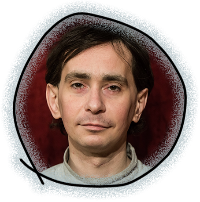
Pianist Pavel Kushnir was an anti-war activist. He died in July in a prison in the Russian Far East. The world only found out about his death days ago. Like Ilya Yashin said during the Bonn conference, many political prisoners in Russia are unaccounted for — “we were finding them everywhere,” Yashin said. The story of Pavel Kushnir is tragic — but it might have easily fallen through the cracks of monitoring systems. When you read this, consider that there are still so many people within Russian prisons whose suffering we know absolutely nothing about.
|
Born in 1984, Kushnir grew up in Tambov, a city in western Russia. Early on he exhibited signs of immense musical talent — his friends refer to him as a bona fide genius. He studied piano first in Tambov and then in Moscow. His career was undeniably going uphill, Pavel’s talent earned him good positions in regional philharmonic orchestras. |
|
|
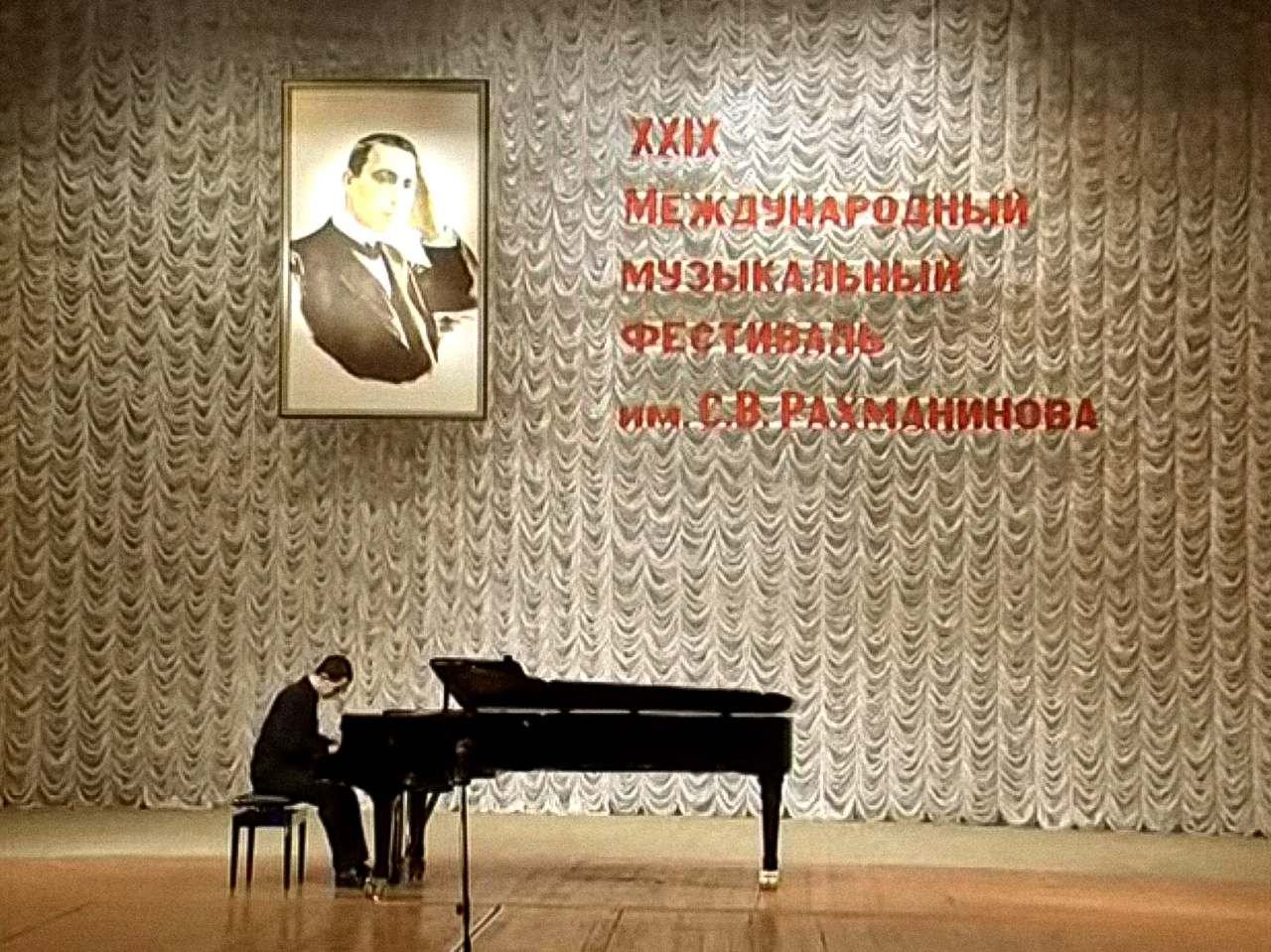
Pavel Kusnir’s performance at the 29th Sergei Rachmaninoff Festival in Tambov, 2011 / Screenshot: Mikhail Kushnir’s YouTube |
|
|
Aside from his refined musical ear, Pavel also had an ear for politics. Even before the 2014 annexation of Crimea, Pavel became politically active, opposing Putin’s creeping authoritarianism, protesting in Moscow during the mass Bolotnaya rallies. Pavel called the annexation of Crimea “criminal” and even wrote a yet-unpublished book, “The Russian Cut-Up”, where he railed against the unfolding war in Ukraine. He also continued to protest — in the streets and online, writing anti-war poetry, and recording videos for his YouTube channel. He never had much of an audience — the channel only had 5 subscribers before Pavel’s passing. He continued on after the full-scale invasion in 2022.
|
“Putin has swollen up like a worm, our fascists are singing hallelujah to him. This is called the Russian Spring” — The Russian Cut-Up. |
Pavel’s friend Olga told Radio Liberty that she invited Pavel to flee the war and join her in Germany. But the pianist refused. He believed he could avoid repression by keeping to smaller, remote cities. This is how he ended up in Birobidzhan, where he worked at a local philharmonic orchestra. Birobidzhan is the definition of remote—in the far east, near the border with China. It is the capital of the Jewish Autonomous Oblast, Stalin’s failed project of creating a Soviet Jewish homeland on the border with Manchuria.
|
“I traveled across the country on the Moscow-Vladivostok train, looked out the window at nature, at the people in the compartment carriage. We have a tragic country, unhappy brutish people, but so much beauty. We can’t give it away to the fascists.” — from Pavel’s letter to a friend.
|
Pavel often gave interviews to regional media, defiant, willing to speak his mind. In May 2024, the FSB detained Pavel. They launched a criminal case against him, for “public calls for terrorism”, supposedly based on his YouTube videos. The FSB agents also found a fake FBI badge at his apartment — perhaps used as a prop. His YouTube channel is called “Foreign Agent Mulder”, a reference to the popular television show X-Files. It had only 4 videos and 5 subscribers at the time of Pavel’s detention.
|
|
|
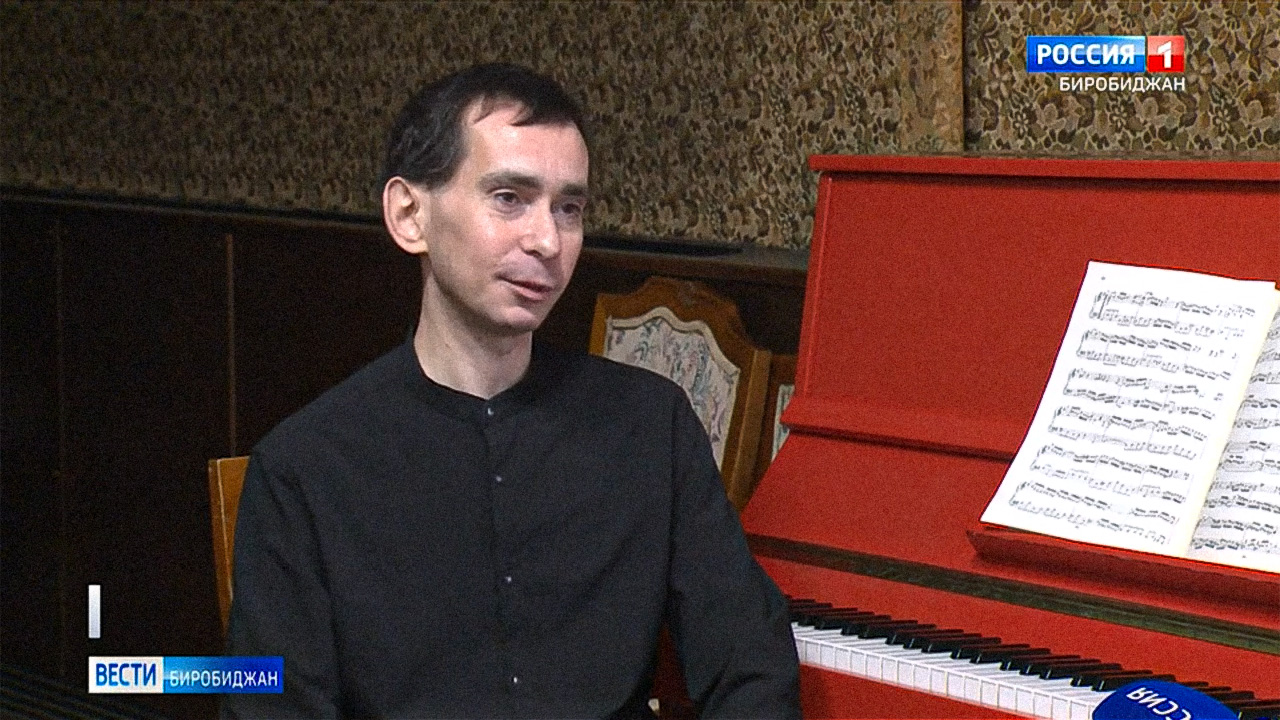
Screenshot from Pavel’s interview to the local branch of the state-owned Russia-1 TV channel, 2023 |
|
|
“I decided to stay and work here [in Birobidzhan] for 12 years, if I don’t get jailed, drafted into the army or fired, then I hope I’ll be with you for the next 12 years” — Pavel’s interview to local media. |
When in prison, Pavel was not on the media’s radar. In prison Pavel declared a hunger strike — a dry hunger strike, meaning no food or liquids. He died shortly thereafter, on 28 of July. His friend Olga told Radio Liberty that she does not believe that Pavel could have died from the hunger strike alone — as he routinely went on hunger strikes after the beginning of the full-scale war. |
|
|
Screenshot: Pavel Kushnir’s YouTube channel |
|
“And I say — down with fucking Putin, down with the fascist Putin regime, down with the war in Ukraine. And [as I say this] in this minute I am free, and one minute of freedom is worth an entire life. Don’t get used to fascism. Don’t get used to war. Putin will die and my love will live... Love is the main enemy of fascism, it is stronger than death. If our antifascist action will be truthful, god will see this, and we will win. ¡No pasaran!” — from Pavel’s YouTube video.
|
|
|
*¡No pasarán! is an anti-fascist slogan, meaning “they shall not pass” in Spanish, originating in the Spanish Civil War. |
|
|
Despite Russia’s official talk about multiculturalism and interfaith harmony — the narrative often touted by the government — the reality on the ground in the 1990s and 2000s was very different. Even after the Soviet era, with its proclaimed «friendship of peoples,» the Russian society was largely xenophobic and Islamophobic.
This article was produced in a collaboration with Daraj Media. Read the Arabic version of the article on their website or check out their English-language page.
|
|
|
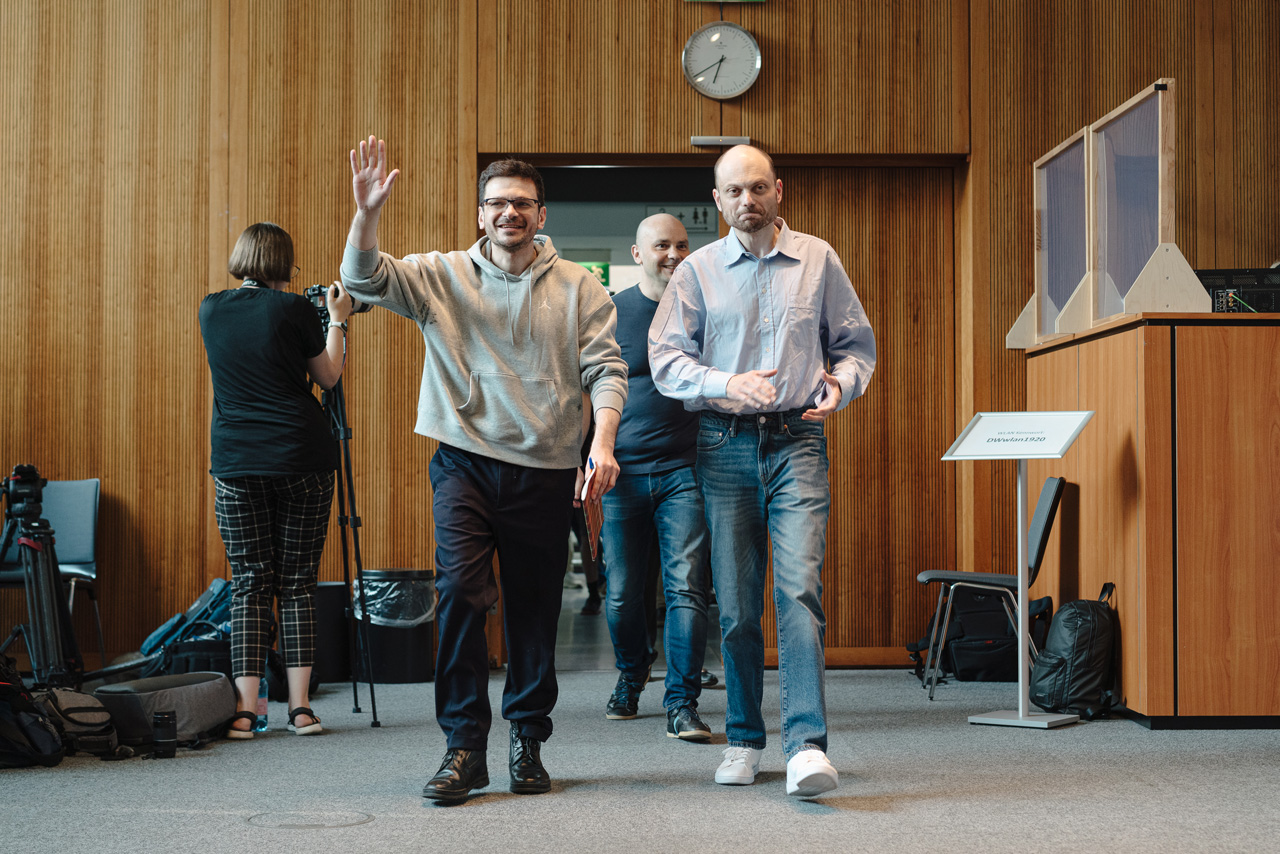
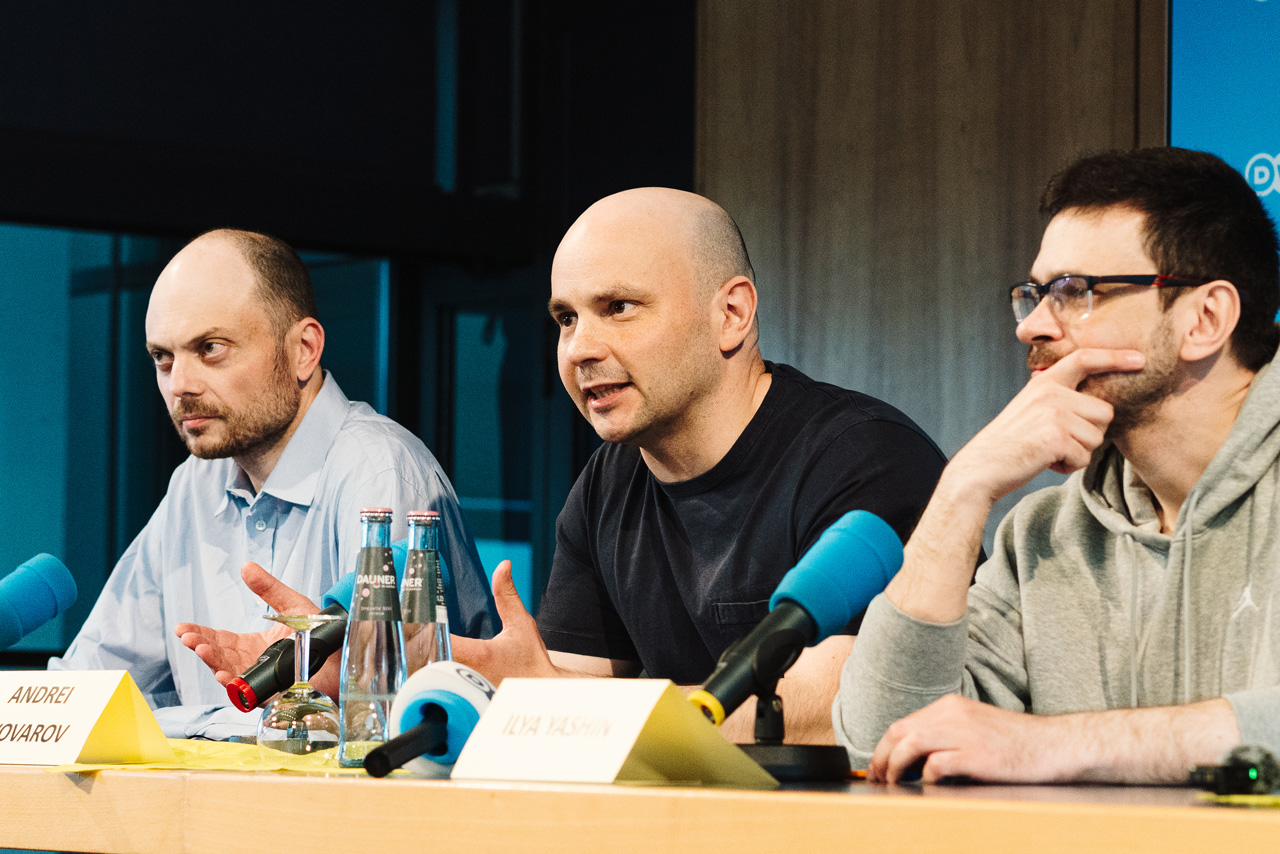
Of the released political prisoners and journalists not everyone has gone public yet. Andrei Pivovarov, Ilya Yashin, and Vladimir Kara-Murza have been the most outspoken thus far. The three politicians held a press conference together in the German city of Bonn. |
In this section, I would like to introduce you a bit more to these three and what they said. I will return to this over the next few issues as we delve further into the profiles of the exchanged prisoners. |
|
|
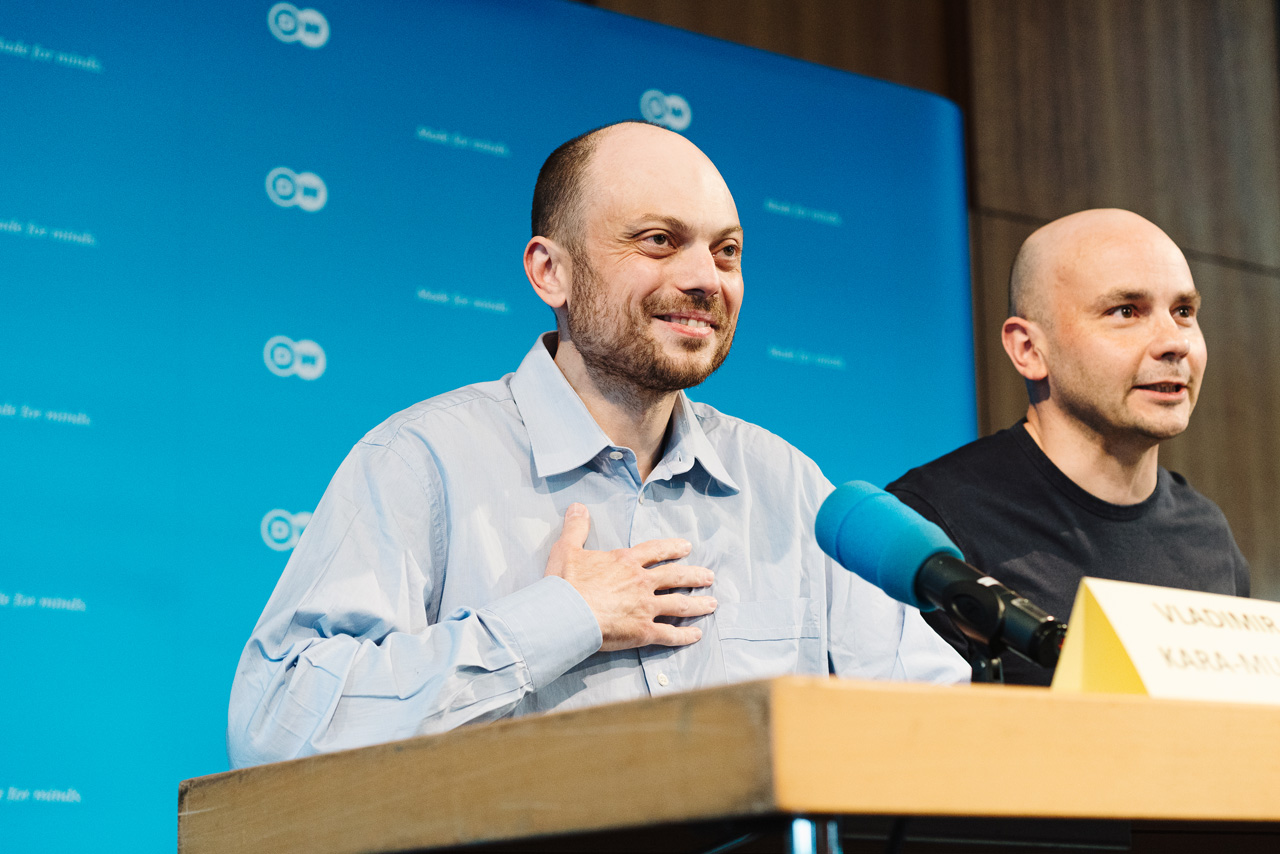
Ilya Yashin, Andrey Pivovarov and Vladimir Kara-Murza enter the press conference room of Deutsche Welle TV channel, their first public appearance after the exchange, 1 August 2024, Bonn, Germany / Photo: Dasha Trofimova for OVD-Info |
|
|
The Bonn conference’s bottom line was fairly straightforward. All three men called for the release of political prisoners and emphasized the criminality and brutality of Putin’s regime. All of them, especially Kara-Murza, called on westerners to differentiate between the Kremlin and regular Russians. One quote of Kara-Murza’s that particularly stood out to me was: “I will work on ensuring that sanctions against Putin’s regime will be sanctions against the regime. In the west people sometimes mistake Russia and Putin’s regime. It was painful to read some highly placed western politicians buying the line of Putin’s propaganda — that all Russians are for war and for Putin. It was really odd to read that I don’t exist, and hundreds more who are jailed for opposing the war... that millions who are against the war don’t exist”. More controversially, they also touched on the topic of sanctions, arguing that they need to target the regime, but avoid hurting regular Russians — bringing to memory the maxim of Boris Nemtsov, Kara-Murza and Yashin’s mentor who was murdered in front of the Kremlin in 2016, “punish the scoundrels, don’t touch the country.”
|
| |
Andrei Pivovarov was the one who kicked off the conference in Bonn. As the Executive Director of Open Russia, Pivovarov has been a key figure in Russia’s pro-democracy and opposition movement. Open Russia was started in 2001 by Mikhail Khodorkovsky, a former businessman and political prisoner, to strengthen civil society and support democratic values in Russia. Pivovarov’s work with Open Russia got him arrested in June 2021 after the Russian government labeled the group, or rather foreign non-governmental organizations with the same name, "undesirable"—a tag that lets authorities ban and target foreign organizations they consider a threat to national security or public order, often those who oppose or criticize the government. In May 2022, Pivovarov was sentenced to four years in a general regime prison.
|
|
|
Andrei Pivovarov at the Bonn press conference, 1 August 2024 / Photo: Dasha Trofimova for OVD-Info |
|
|
Before going into politics full-time, Pivovarov was a successful entrepreneur. He started a brewing business in the late 2000s, and fun fact: his last name, ’Pivovarov,’ means “brewer.” He also opened “Freedom”, a St. Petersburg bar that became a hot spot for opposition voices where figures like Boris Nemtsov, a prominent Russian opposition leader assassinated in 2015, and Ilya Yashin gave talks in 2012 and 2013. |
|
|
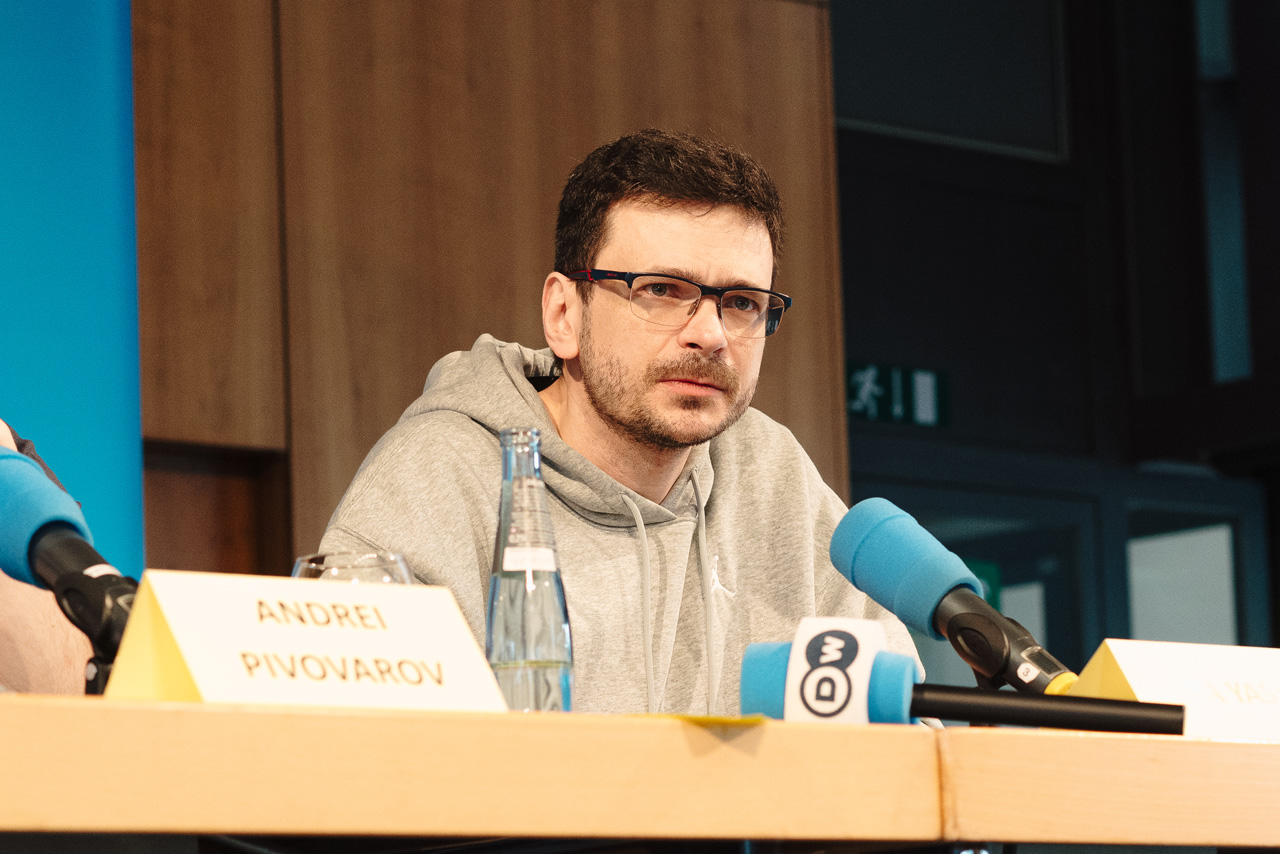
Ilya Yashin has been a key figure in Russia’s opposition scene since the early 2000s. He was a deputy for Moscow’s Krasnoselsky district from 2017 until mid-2021. In 2022, Yashin was vocal against Russia’s invasion of Ukraine but decided to stay in the country, continuing to speak out against the Kremlin. He was detained on June 28, 2022, for “disobeying the police,” and a few weeks later, he faced charges under the “fake news” law for a video about the Bucha massacre that he posted on YouTube. He was also labeled a “foreign agent” while in pre-trial detention. In December 2022, Yashin was sentenced to 8.5 years in prison.
|
|
|
Ilya Yashin at the Bonn press conference, 1 Augus 2024 / Photo: Dasha Trofimova for OVD-Info |
|
|
Even behind bars, Yashin has kept speaking out against the war and Putin. In a powerful speech at the Moscow City Court in April, 2023, he said, “No court and no verdict will silence me. This is my duty and my mission. No to war!”
|
|
|
Vladimir Kara-Murza is a well-known Russian opposition figure, journalist, and publicist. He began his political career in the late 1990s, becoming a close ally of Boris Nemtsov over time. Kara-Murza was key in pushing the Magnitsky Act through the U.S. Congress in 2012, which targeted Russian officials for human rights abuses by imposing visa bans and asset freezes on them. Kara-Murza survived two major poisonings in 2015 and 2017, which many believe were assassination attempts.
|
|
|
Vladimir Kara-Murza at the Bonn press conference, 1 Augus 2024 / Photo: Dasha Trofimova for OVD-Info |
|
|
On April 22, 2022, Kara-Murza was labeled a “foreign agent” by Russia’s Ministry of Justice. He was sentenced to 25 years in prison on April 17, 2023, on charges of treason, spreading “fake news,” and working with an “undesirable organization” (as a coordinator for Open Russia). His charges were based on his criticism of the war in Ukraine, his claims about rigged Russian elections, and his discussions on state terror and media censorship in Russia. In 2024, he won the Pulitzer Prize for Commentary for his texts written from prison, where he continued to criticize the Kremlin.
|
Before becoming involved in politics, he studied History at Trinity Hall, Cambridge University, focusing on the Soviet dissident movement. He holds dual Russian-UK citizenship. |
|
|
Sources cited in the reading list are not necessarily aligned or in a formal partnership with us. It is just what the editor finds interesting. |
|
|
The Digest is created by OVD-Info, written by Dan Storyev & Inna Bondarenko; edited by Dr Lauren McCarthy |
OVD-Info English newsletter privacy policy: how we work with your data |
|
|
|